
Scrum: what it is, how it works and how to implement it
Quick summary: Scrum in a few sentences
Scrum is an agile framework for developing complex products in short cycles called Sprints, which usually last between one and four weeks.
In each Sprint the team selects items from the Product Backlog, works to turn them into a usable increment and inspects the result with stakeholders.
The framework rests on three pillars — transparency, inspection and adaptation — and defines a small set of accountabilities, events and artifacts that keep the work organized.
Before diving into reading:
Scrum looks simple on paper, and that is intentional: the framework defines only what is essential and leaves the rest to the team. The sections below explain how it works in practice and what to watch for when adopting it.
If you are evaluating Scrum alongside other approaches, this article pairs well with the introduction to Kanban and the Scrum versus Kanban comparison.
1) What is Scrum?
Scrum is an agile framework created to help teams develop complex products incrementally. Instead of planning everything upfront and delivering at the end, the team delivers a small, usable piece of the product at every cycle and adjusts course based on what it learns.
Scrum is deliberately lightweight. It defines accountabilities, events and artifacts, but it does not prescribe engineering techniques, tools or detailed processes. That is why it can be applied to software, marketing campaigns, research and many other kinds of knowledge work.
2) How Scrum works: the Sprint
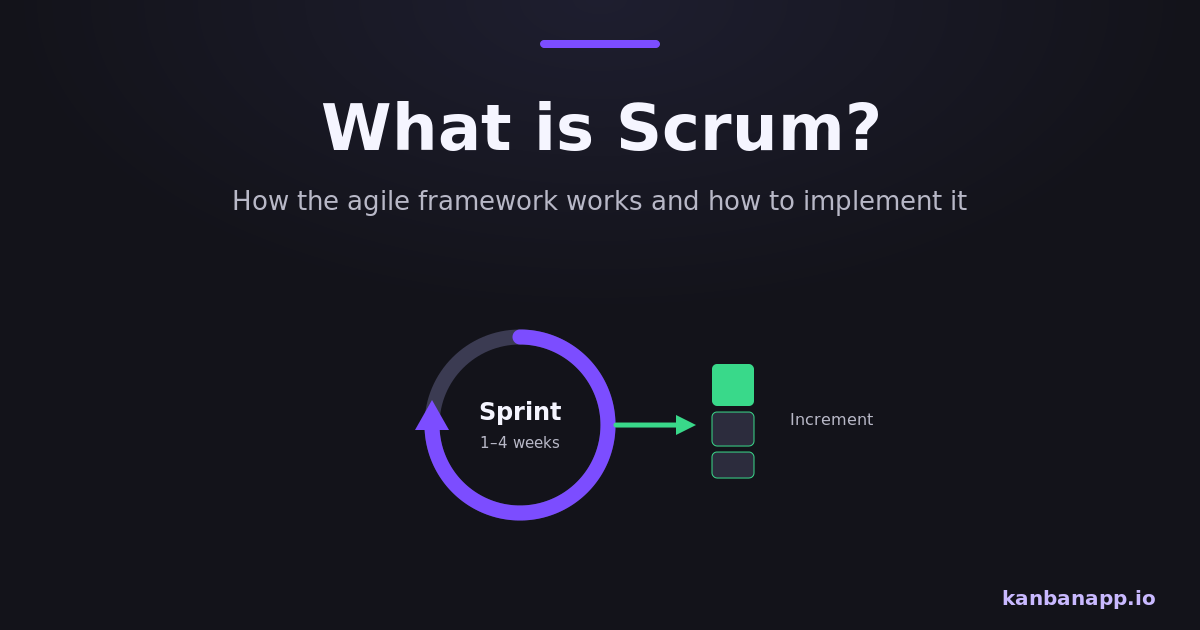
All work in Scrum happens inside Sprints: fixed-length cycles of one month or less. A Sprint starts with planning, continues with daily coordination and ends with a review of the product and a retrospective about the process.
Each Sprint has a Sprint Goal — a single objective that gives the cycle focus. At the end, the team should have a Done increment: something usable that moves the product forward, even if it is small.
3) The three pillars: transparency, inspection and adaptation
Scrum is built on empiricism: the idea that in complex work, knowledge comes from experience and decisions should be based on what is observed. This produces the three pillars.
- Transparency: the work and its state must be visible to those doing it and those receiving it.
- Inspection: progress toward goals is examined frequently, in the Scrum events.
- Adaptation: when something drifts outside acceptable limits, the team adjusts the plan, the product or the process.
Every Scrum event exists to support this loop. When one pillar weakens — for example, when the real state of the Sprint is invisible — the whole framework loses power.
4) Accountabilities, events and artifacts at a glance
The Scrum Team has three accountabilities: the Product Owner, who maximizes the value of the product and manages the Product Backlog; the Scrum Master, who helps the team and the organization apply Scrum well; and the Developers, who create the increment.
The events are the Sprint itself, Sprint Planning, the Daily Scrum, the Sprint Review and the Sprint Retrospective. The artifacts are the Product Backlog, the Sprint Backlog and the Increment, each with a commitment: the Product Goal, the Sprint Goal and the Definition of Done. The complete Scrum guide covers each element in depth.
5) Benefits of working with Scrum
Teams adopt Scrum because short cycles reduce risk: instead of discovering problems months later, feedback arrives every Sprint. Priorities can change between Sprints without destroying the plan, and stakeholders see real progress instead of status reports.
Scrum also gives the team a protected space. During the Sprint, scope is stable enough to focus, and the retrospective guarantees a regular moment to improve how the team works — not just what it delivers.
6) First steps to implement Scrum
Start small and concrete: choose one team, one product and one backlog. Name a Product Owner who can really decide priorities, agree on a Sprint length (two weeks is a common starting point) and schedule the events as recurring meetings before anything else.
Write a first version of the Definition of Done, even if modest, and make the Sprint Backlog visible to everyone — a simple board with To Do, Doing and Done is enough to start. A free tool like KanbanApp works well for this, as shown in the Scrum board article.
7) Common mistakes when starting
The most frequent mistakes are treating Scrum as a reporting ritual instead of a working agreement: running Dailies as status meetings, skipping retrospectives when time is short, and letting the Sprint absorb new scope every day until the goal is meaningless.
Another trap is adopting the vocabulary without the pillars. If the state of the work is not transparent, inspection sees nothing and adaptation never happens. Fixing visibility first — usually with a good board — makes every other part of Scrum easier.
8) Conclusion
Scrum organizes complex work into short, focused cycles with clear accountabilities and a built-in improvement loop. It is easy to start and hard to master — and most of the difficulty is discipline, not mechanics.
Begin with one team, real events, a visible Sprint Backlog and a modest Definition of Done. Inspect and adapt from there: that is Scrum working as intended.