
Scrum versus Kanban: differences, similarities and which to choose
Quick summary: the comparison in brief
Scrum organizes work in fixed cycles (Sprints) with defined accountabilities and events; Kanban organizes work as continuous flow with visualization and WIP limits.
Both are agile: they favor frequent delivery, transparency, adaptation and continuous improvement.
Choose Scrum when goal-oriented cycles and role clarity help; choose Kanban when demand is continuous and priorities shift daily; combine them when you want both.
Before diving into reading:
Scrum versus Kanban is rarely an either/or decision, but understanding the real differences prevents bad fits. This article compares them dimension by dimension.
If you need the fundamentals first: what is Scrum and what is Kanban.
1) Two approaches, one agile mindset
Scrum and Kanban share the agile DNA: deliver frequently, welcome change, make work transparent, inspect results and improve continuously. Neither is "more agile" than the other — they express the same values through different mechanics.
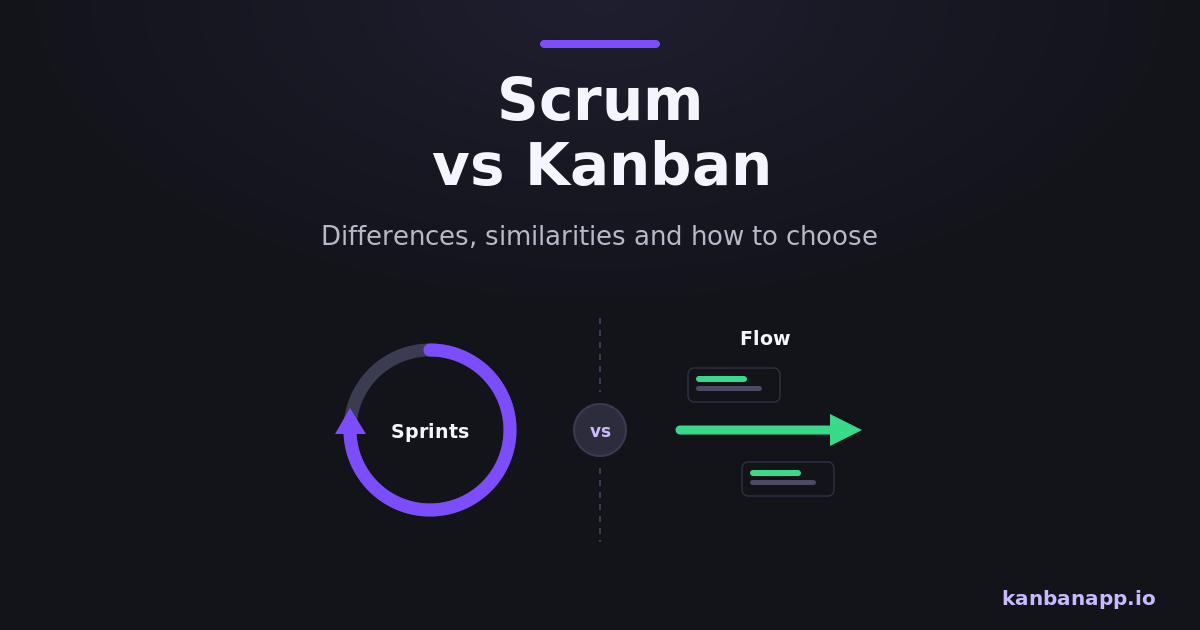
The core difference is the unit of organization. Scrum organizes time: fixed Sprints with a goal. Kanban organizes flow: continuous movement through a visualized process.
2) Cadence: Sprints versus continuous flow
In Scrum, work is batched into Sprints of one month or less; planning, delivery and review follow that heartbeat. The Sprint provides focus and a natural checkpoint, at the cost of batching.
In Kanban, items enter and leave individually; there is no cycle to wait for. Cadences exist (dailies, reviews) but are decoupled from delivery, which can happen any day. Flow provides responsiveness, at the cost of the focusing pressure a Sprint Goal gives.
3) Roles and accountabilities
Scrum prescribes three accountabilities — Product Owner, Scrum Master and Developers — and a self-managing team structure around them.
Kanban prescribes none: you start with your current roles and evolve. Specialized roles like service request manager may emerge, but they are optional. Teams that need role clarity get it from Scrum; teams that cannot restructure get a gentler start from Kanban.
4) Planning and commitment
Scrum plans per Sprint: the team forecasts what fits, commits to a Sprint Goal and protects it for the cycle. Velocity — items or points per Sprint — supports forecasting.
Kanban plans by replenishment: whenever capacity opens, the next most important item is pulled. Forecasting uses flow metrics such as cycle time and throughput. Commitment happens per item at the moment it is pulled, not per batch.
5) Priority changes and interruptions
Scrum absorbs change between Sprints; mid-Sprint changes are possible but disruptive by design, since scope stability protects the goal. Frequent urgent interruptions strain the model.
Kanban absorbs change continuously: the next pull simply takes the new top priority, and urgent classes of service can even bypass the queue. Support, operations and maintenance teams usually feel this difference immediately.
6) WIP limits and delivery frequency
Kanban limits WIP explicitly per stage; that is its engine. Scrum limits WIP implicitly — the Sprint Backlog caps a cycle's scope — but nothing stops all items from being started at once inside the Sprint, which is why many Scrum teams add explicit limits.
Delivery in Scrum happens at least once per Sprint; in Kanban, as soon as each item is done. Teams that can release continuously often lean Kanban; teams whose stakeholders prefer batched reviews often lean Scrum.
7) Which one to choose?
Lean toward Scrum when work is project-like with meaningful goals, when the team benefits from strong structure and role clarity, and when stakeholders engage well with cycle reviews. Lean toward Kanban when demand is continuous and unpredictable, when priorities change faster than a Sprint, and when reorganizing roles is not an option.
- Product team building toward a roadmap: Scrum fits naturally.
- Support or operations queue: Kanban fits naturally.
- Development team with frequent production incidents: usually a combination.
- Team starting from chaos, no mandate to reorganize: Kanban first, structure later.
And remember the third option: the approaches combine well, as covered in Scrum and Kanban together and Scrumban.
8) Conclusion
Scrum gives you a goal-driven cadence with clear accountabilities; Kanban gives you continuous flow with explicit limits and evolutionary change. Both deliver frequently, adapt and improve — they just organize the work differently.
Choose by the shape of your demand and your freedom to structure the team. Or take the practical route many teams end up on: Scrum for cadence, Kanban for flow, together.