
Agile methodologies: differences between Agile, Scrum and Kanban
Quick summary: three concepts, one hierarchy
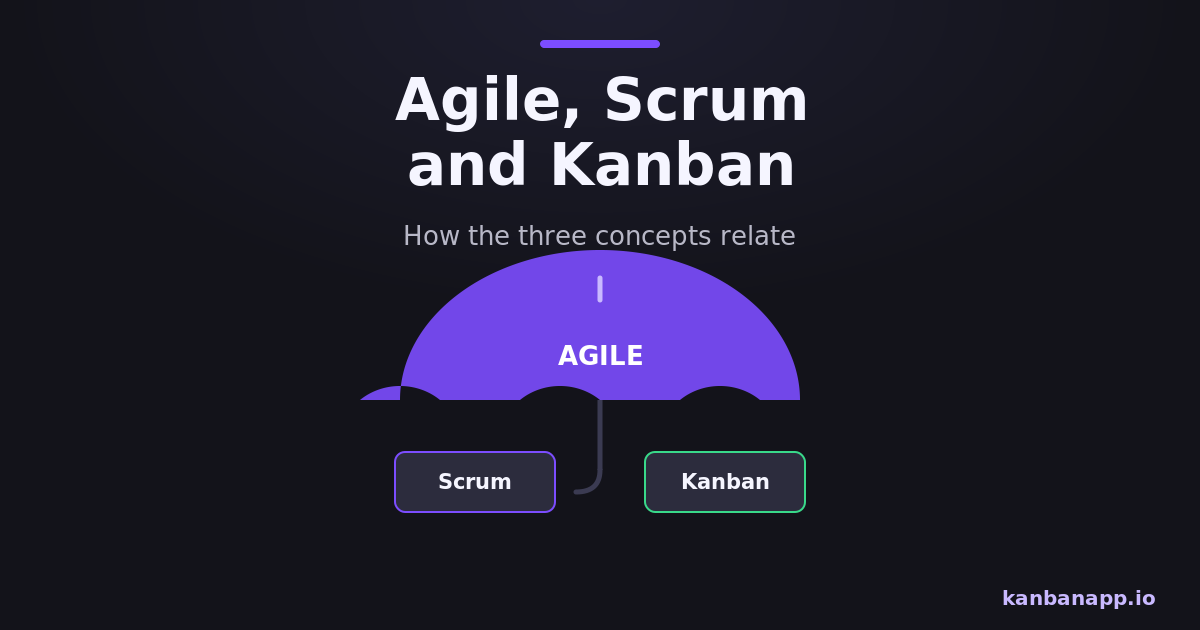
Agile is not a method: it is a set of values and principles, formulated in the Agile Manifesto, about how to deal with complex work — favoring individuals, working results, collaboration and response to change.
Scrum is a framework that expresses those values through Sprints, accountabilities, events and artifacts.
Kanban is a method that expresses them through visualization, WIP limits and flow management. They are not rivals: Scrum and Kanban are two practical paths under the same agile umbrella.
Before diving into reading:
Few confusions cost teams more than treating Agile, Scrum and Kanban as three competing methodologies. This article puts each concept in its place and shows how they combine.
For depth on each practice, see what is Scrum and what is Kanban.
1) Agile: values and principles, not a process
Agile was named in 2001, when the Agile Manifesto condensed a decade of lightweight methods into four values: individuals and interactions over processes and tools; working software over comprehensive documentation; customer collaboration over contract negotiation; responding to change over following a plan.
Twelve principles accompany them — frequent delivery, sustainable pace, reflection and adjustment. Notice what is absent: no roles, no meetings, no boards. Agile tells you what to value, not what to do on Monday morning.
2) Scrum: a framework within agile
Scrum answers the Monday-morning question with structure: work in Sprints of a month or less, three accountabilities, five events, three artifacts with commitments. It implements agile values through empiricism — transparency, inspection, adaptation on a fixed cadence.
Scrum is prescriptive about its own skeleton and silent about everything else: it does not tell you how to code, design or even how to track work inside the Sprint. The complete Scrum guide details the framework.
3) Kanban: a method within agile thinking
Kanban answers the same question with flow: visualize the work, limit WIP, manage and measure flow, make policies explicit, improve evolutionarily. It shares agile's emphasis on transparency, frequent delivery and adaptation, while prescribing no roles or cycles.
Where Scrum installs a structure, Kanban evolves the structure you have. The Kanban Method guide covers its principles and practices.
4) How the three relate
Think of it as levels: Agile is the philosophy — the why. Scrum and Kanban are operating models — two different hows. A team "doing agile" is always doing it through some concrete practice set, whether Scrum, Kanban, a blend or something else entirely.
This is why "Agile versus Scrum" is a category error, and "Scrum versus Kanban" is a real but friendly choice — compared in detail in Scrum versus Kanban.
5) Common misconceptions
- "We do agile" meaning "we do Scrum": Scrum is one expression of agile, not its definition.
- "Kanban is just a board": the board is one practice; the method includes limits, policies, metrics and cadences.
- "Agile means no planning": agile plans continuously instead of once.
- "Scrum and Kanban are incompatible": they combine so well the blend has a name — Scrumban.
- "Daily meetings make us agile": rituals without transparency, inspection and adaptation are just meetings.
Each misconception fades once the hierarchy is clear: values at the top, practices underneath, results as the test.
6) Choosing your combination
Start from your demand pattern. Goal-driven product work benefits from Scrum's cadence; continuous, interrupt-heavy demand benefits from Kanban's flow; mixed realities benefit from combinations like Scrum with Kanban or Scrumban.
Whatever you pick, judge it by agile's own standard: are we delivering value frequently, learning from feedback and improving how we work? If yes, the label matters little.
7) Conclusion
Agile is the value system; Scrum and Kanban are two proven ways to live it. Understanding the difference dissolves most methodology debates and frees the team to focus on what matters: flow of value, feedback and improvement.
Learn both practice sets, pick what fits your work, and let the manifesto — not the ritual — be the measure.