


What is Kanban?
Quick summary: what is Kanban and how it can help us in everyday life
In practice, Kanban is a work management method that relies on a visual system (the Kanban board) to represent the flow and make management more organized, fluid and easy for everyone to follow.
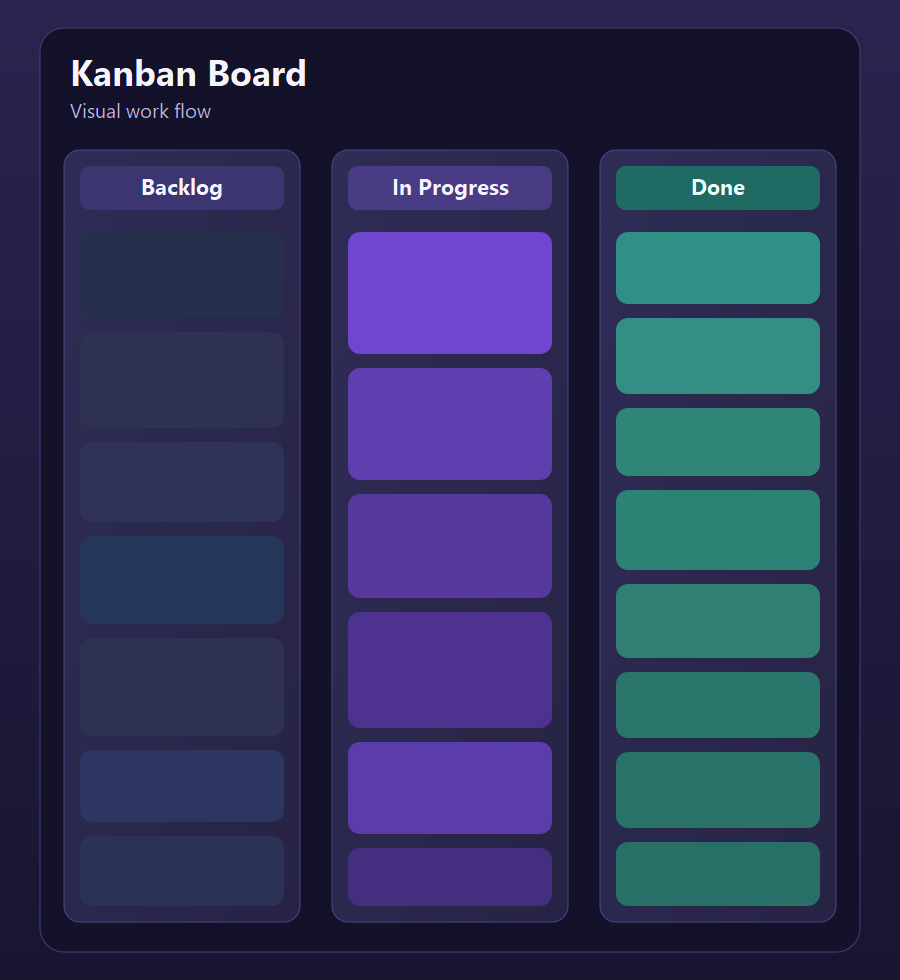
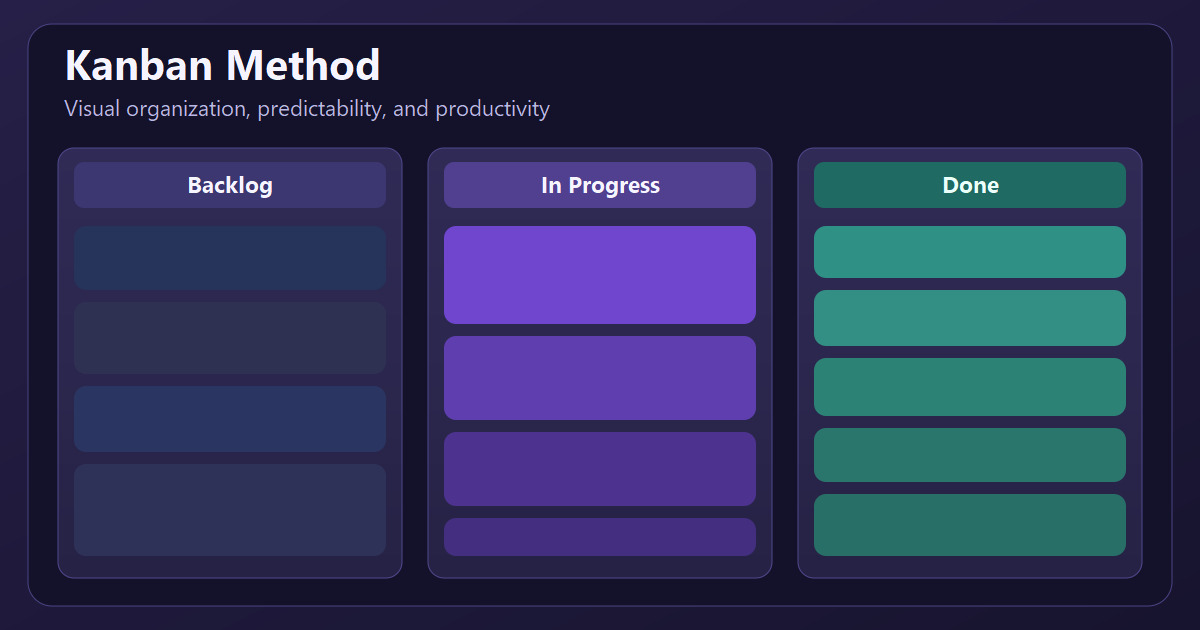
This table is made up of columns, which indicate the stages of the process, and cards, which represent the tasks. In many cases, it organizes activities into three main groups: to do, in progress, and completed.
Each card brings together the description of the work and the criteria for considering it completed. According to the cards advance through the columns, the task path becomes explicit and the flow of the project or operation becomes very clearer.
With this view, the team gains an overview of what is pending, what is in progress and what has already been delivered, facilitating organization, prioritization and continuous management improvement.
Try it in practice: KanbanApp (offline kanban board, private and without registration)
Learning Kanban is much easier when you use onekanban boardreal. THEKanbanAppis akanban boardsimple that runsdirectly in the browser- no login, no install nothing and without depending on a server. It was designed for those who want productivity with privacy, including incorporate use.
You can access KanbanApp at https://kanbanapp.io or at GIthub. If you prefer, use it offline: download the HTML file and open it directly in your browser.
Why does this work in the corporate world?
- No installation: Ideal for IT-constrained PCs.
- No registration: open and use.
- No cloud: the data remains100% browser cache/storage locally.
- Backup to file: export whenever you want and keep your board with you.
- Offline: useful when traveling, environments without internet or restricted networks.
First Insights When Starting to Use a Kanban Board:
- The first impression when using the Kanban method with a KanbanApp board is that of work organization and mastery of tasks, even in extremely detailed and voluminous flows.
- In daily use, you notice that you start to forget a lot less things and miss a lot fewer details.
- With this consistency, the team tends to perceive you as a professional distinguished by your clarity and reliability in execution.
Kanban, Scrum and Agile - can they be combined?
Yes. Think of Kanban as a way tomanage the flowof work (and not a closed process). You can use Kanban withscrumand other approaches from the agile universe.
Before diving into reading:
You've already seen here that a Kanban board in application format can help organize work, reduce forgetfulness and provide more clarity to the team. From now on, the content delves deeper into the fundamentals that transform this initial sensation into results consistent on a daily basis.
When applying the next concepts, it is common to feel a clear evolution in controlling demands and a relevant leap in productivity, even in complex and voluminous flows.
1) An overview of Kanban
Kanban takes an evolutionary improvement approach: youStart with what you do today, combines small, incremental changes and encourages leadership at all levels. It also has principles oriented toservice delivery, focusing on customer needs and continuous improvement.
It's a way to improve the engine while the car is running, without having to stop everything.
1.1 Method, methodology or framework?
THEKanbanis presented asa management method(and not a methodology prescriptive) because hedoes not replacethe way you already work doesn’t even impose a “step by step” step” closed; he isaddedto the existing process to make the work moreOf course,stableandpredictable. Instead of changing everything at once, you start by applying practices likeview the workflow(leave steps, rules and transparent items),control/limit WIP(reduce congestion, queues and exchange of context) andmanage the flowfocusing on completing at a sustainable pace and predictability. With Therefore, the system starts to showbottlenecksand day-to-day decisions, allowing you to adjustpolicies, reduceoverloadand improve thedelivery of servicescontinuously — that is, Kanban serves as a “reinforcement” that improves what and how you already does, rather than being a prescriptive package to change your current process.
1.2 Principles
In Kanban, the principles work as “guideline rules” for you to improve your work without having to start from scratch. In Change Management, the idea is to start with what you do today, that is, respect the way current way of working and using it as a starting point; then agree to seek improvement through change evolutionary, promoting continuous adjustments guided by learning (rather than a sudden transformation); and encourage acts of leadership at all levels, valuing small improvement initiatives from any person, not just formal positions. In Service Delivery, Kanban reinforces a customer-oriented vision: understand and focus needs and expectations, manage work and enable self-organization around it, and regularly review the service network and its policies to adjust the system and improve results over time.
2) Kanban practices
In Kanban, there is a set of practices that serve as a basis for putting the system into operation and evolve it over time. THEKanban Guidepresents a triad of practices — defining and visualizing a flow of work, actively manage items in the flow, and continually improve the workflow — that works as an “essential minimum” to guide adoption and ensure more clarity, pace and predictability in deliveries. From this base, Kanban practices help transform the board and cards into a management system. work, making it clear how activities progress, how to prioritize better and how to identify bottlenecks to continually improve.
These two lists don't fight each other; they complement each other:
Three practices (Kanban Guide)
- Set and viewa workflow.
- Actively manageitems in the stream.
- To improvecontinuously the workflow.
3) WIP and Pull system
WIP (Work in Progress)is the number of items that areinside the flowin a given moment — and it is a direct “thermometer” of the health of your system. When you let WIP grow too much, you take the “slack” out of the system: everything is 100% busy, queues appear, context switching increases (at work of knowledge, this reduces effectiveness), and the flow becomes a congested highway — that is, thelead time/cycle time tends to increase and predictability drops. :contentReference[oaicite:0]{index=0} In addition Furthermore, there is a well-known relationship betweenmore WIP and longer cycle time, and many studies point out that limiting WIP helps avoid capacity overload and reduce times.
The most important point is thatWIP limits are not “just a number”: they saw a rule operational thatstrength focus and collaboration. When the “In Progress” column is at its limit, the team stops pushing new things and startsfinishwhat has already started (unblocking bottlenecks, removing impediments, helping those who are blocked). This is what makes Kanban operate likesystem pulled: You only pull new work when there is real capacity for it. And theexceptions(for example, an urgent item) should not “break through” the system informally; they need to be foreseen inexplicit policies, as rules forclasses of service, including making it clear when a class can exceed the limit and what happens to the remainder of the flow.
4) DoW (Definition of Workflow) and Kanban Board
Important DoW concepts:
- Work Items: unit of value that crosses the flow.
- Starting pointandend point.
- Defined Statesthrough which items flow.
- WIP Controlfrom end to end.
- Explicit Policiesfor movement.
- SLE(Service Level Expectation): time + probability to traverse the system.
The Definition of Workflow (DoW) is one of the central concepts of Kanban, as it represents the explicit and shared understanding of how work flows within the system. She defines clearly what the work items (value units) are, where the work begins and ends, by what states it passes through, how WIP (Work in Progress) is controlled from end to end and what the policies are explicit for movement between steps. When the team looks at the board and everyone interprets the flow of the same way, it means that DoW is working correctly. This alignment reduces ambiguities, improves predictability and strengthens the focus on delivering value — exactly as guided by the Kanban method.
The Kanban Board is the visual materialization of DoW. It makes the flow transparent, highlights bottlenecks and allows actively manage work in progress. By limiting WIP and defining clear policies for movement, the system promotes balance between demand and capacity, increasing efficiency and predictability. The SLE (Service Level Expectation) complements this structure by establishing a time expectation with a given probability for an item to pass through the system, strengthening data-based management. In practice, using a digital board like KanbanApp (https://kanbanapp.io) facilitates this implementation, as it allows configure/manage states, WIP limits, explicit policies and follow the flow in a clear, professional and safe way — even offline and without the need for installation. Thus, Kanban theory becomes daily practice, applicable both in corporate and corporate environments. personal.
If the team looks at the board and understands the same thing, the DoW is working.
Kanban board in practice
The board is a visualization of the DoW. There is no universal "one right picture"; the frame should reflect the context real. The important thing is that the flow is visible, the limits are clear and the policies are explicit.
5) Explicit Policies, Blocks, and Stream Quality
Explicit policies are your “operational manual.”Kanban:simple rules, visible and awakethat tell how work should flow for the system to continuepredictableandhealthy. They cover fromentry criteria and exit(what can enter this stage? when can it leave?) to what it means“ready” in each column(Definition of Done per step), such asflag and treat blockages(when a item is considered locked, how to mark it on the board, what is the expected reaction time and who helps to unlock it), how does it happenrefueling(who decides, when they decide and how much work comes in) and how deal withemergency(e.g. service classes like Expedite) without messing up the flow. In practice, explicit policies transform decisions “on the spur of the moment” intorepeatable, leaving the fairer system, faster to operate and easier to improve.
The direct gain isreduce friction: with clear rule, you haveless guesswork, less circular debate and more objective decisions based on what was agreed. For example, if the “In” column validation” has aDonespecific, reduces rework and “back and forth”; whether blocked items have an escalation policy (e.g. after 24 hours blocked becomes priority for unlocking), the team does not let problems fester; If replenishment has criteria (capacity, size of items, priority), the team protects the input and prevents overload; and if the limits ofWIPand the rules forclass of serviceare explicit, everyone understands whenhe canpull whenit cannot, and what happens when an urgent situation arises. This checklist you put together is great exactly because this: it covers the policies that most impactflow,qualityandpredictability.
Useful policy checklist
- Definition of Done by column/step.
- Rules for blocked items (flagging and resolution).
- Replenishment (who decides, when and how much comes in).
- WIP limits per column and/or global.
- Rules by class of service.
6) Metrics and flow management
Metrics inKanbanexist formake better decisions about flow, no to “decorate dashboard”. The logic is very practical: if you measure the flow, you see thehealth of systemand manage to act before it turns into chaos. NodeOfficial Guide, the “main metrics” highlighted areLead Time(from the point of commitment to completion),fee delivery/flow(items completed per unit of time) andWIP(number of items in the system), and they feed graphs that help understand the system's behavior and identify improvements. :contentReference[oaicite:0]{index=0} NoKanban Guide (v2020.12), the focus is even more “operational”: it defines a minimum set ofmandatory flow measures—WIP,Throughput,Item ageandTime of cycle (Cycle Time)— because they are the ones that really allow you to inspect and adjust the system on a day-to-day basis day, with a start and end defined in yourDOW.
In practice, these metrics complement each other:WIPshows how much work is “clogging up” the system now;Flowshows how much you can finish per period;Time of cycleandLead Timeshow “how long it takes” (in different sections), and theItem ageis a simple alarm to detect items that are getting too old and need attention. And this is where the Official Guide's useful visualizations come in: arun chartLead Time/Cycle Time helps you seetendenciesover time; thedistribution of Lead Timeshows thepredictability(the goal is to narrow the lane and move to the left); and theCFD (Cumulative Flow Diagram)makes it visible where the WIP is “piling up” and where the bottlenecks are in the flow.
6.1 Central concepts
- Lead Time: from the point of commitment to delivery/completion.
- Cycle Time: from the beginning to the end of the item (defined in the DoW).
- Throughput: items completed per unit of time.
- Work Item Age: How long the item has been in progress.
- WIP: items in progress in the system (or part of it).
6.2 Mandatory minimum measures
To operate and improve the system, follow at least:
- WIP
- flow
- Item age
- Cycle time
6.3 Useful views
- Run chartof time (lead/cycle) to see trend.
- Lead time distributionto understand predictability (narrow and shift to left).
- CFD(Cumulative Flow Diagram) to see where WIP “stacks up” and reveal bottlenecks.
6.4 "Kan-Bahn": traffic metaphor
“Kan-Bahn” is a metaphor fortransitto explain how work flows within a system: when the “road” (capacity) gets very busy, any small variation generatescongestion. In work environments, this appears asWIP high(a lot of things going on at the same time), morequeues, morelocksand morecontext switching— which reduces thefluidityand knock downpredictability. The logic of Kanban, in this analogy, isdecrease the congestioncontrolling WIP, organize the flow so that items advance more consistently and usedata from the system itself(e.g. times and queues) to adjust policies and improve the ability to predict deliveries.
In this context, thepoint of commitmentis an important milestone: it is when a demand stops from being just an option in the “backlog” and becomes areal commitmentof delivery. From there, do meaning to measure thelead time— the time that passes from this commitment to thedeliveryto the customer — because it is in this part of the flow that you want to increase reliability: less variation, less delay and morepredictabilityfor those who are waiting for the result.
7) Types of work and Classes of service
Not every type of demand has the same “weight” or the same urgency, soTypes of workandClasses of serviceexist for you to clearly definelike different items enter and are processed in the system. NodeKanban Guide, the analogy is that of traffic: just asambulances, firefighters and vehiclesmay have priority on the road, some work items may receive differentiated treatment — this is aClass of Service. The most “classic” class is theExpedite (urgent): It allows an authorized item to pass fastereven when the WIP limit is exceeded, but this only works well when there isagreed criteria and rules and known to everyone(who can use it, under what conditions, how to signal, and what the team does to “open the way”).
The central point, therefore, isconsistency with transparency: urgency can (and will) exist, but it needs to come withexplicit policyso as not to become an “informal emergency” that breaks the flow every day. HimselfKanban Guidereinforces that explicit policies include, in addition to WIP limits,Policies for handling items from different classes of service, and that these policies must bevisible, simple and agreed together, in addition to being revised over time. So, you keeps the exception (Expedite) under control, protects the predictability of the rest and prevents “queue jumping” from becoming routine.
The main point is to maintain consistency: urgency may exist, but with a visible rule.
Service classes:
- Expedite (Urgent): item authorized to receive priority and “skip the queue” in a controlled, with explicit rules.
- Normal: standard category, follows the normal system flow, without special privileges.
- Special: category different from normal, for items that require treatment specific, without the same privilege as Expedite.
8) Cadences and feedback loops
Kanban emphasizesfeedback loopsto promoteinspection and adaptationcontinuous flow, and thecadencesThese are precisely meetings/reviews with a defined purpose that support this improvement on a daily basis, always adjusted to the context of the team and the service. In general,shorter, more objective loopswork better than long meetings because they keep the focus on the that really unlocks the system: inTeam Kanban Meeting(often daily), the team observes the framework, identifies blockages and decides next steps based oncapacityavailable; nodeReplenishment(weekly or when necessary), the group selects what will enter the system, maintaining a “healthy input” aligned to the pull model; and inRetrospective(fortnightly or monthly), the focus is to evolvepolicies,limitsand data-based practices and learning, reinforcing continuous improvement of the flow.
Below is a summary of the cadences and feedback cycles:
| Cadence | Frequency (example) | Purpose |
|---|---|---|
| Team Kanban Meeting | Daily | Observe flow on the board and decide next steps based on capacity and blockages. |
| Replenishment | Weekly (or as needed) | Select what enters the system (pull), ensuring healthy input. |
| Retrospective | Biweekly or monthly | Improve data-driven policies, limits and practices. |
9) STATIK (System Thinking Approach to Introducing Kanban)
THESTATIK(System Thinking Approach To Introducing Kanban) is an approach in the format ofworkshoptodraw or redesigna Kanban system consciously, usingsystemic thinkingandcontinuous feedback. Instead of putting together a frame “on guesswork” (just copying standard columns), STATIK assumes that the table is just the “tip visible” of a larger system:policies,limits,cadences,metricsand agreements. Therefore, it starts by looking at the real context of the service and what is causing pain today, and then turn those findings into a flow design that makes sense and can be adjusted with data over time.
A typical flow includes:
- Identify sources of dissatisfaction.
- Analyze demand (what arrives, patterns, types).
- Analyze capacity (flow, times, predictability).
- Model the flow (activities/steps).
- Identify service classes.
- Design the Kanban system (board + policies + metrics + cadences).
The result is a Kanban that is born “connected” to the work real, easier to operate, measure and continually improve.
10) Kanban in industry and Theory of Constraints (T.O.C)
In manufacturing, Kanban appears as a card system to control replenishment and stock, avoiding excess and lack of material and aligning production with demand (pull production). Below we have the definition ofTheory of Constraints (T.O.C), especially the methodDrum-Lung-RopeandProduction and movement kanbanTo synchronize the system to the bottleneck:
THETheory of Constraints (T.O.C.), in the context of Kanban, is the way of seeing the system of work as a flow in which the outcome (delivery, speed, predictability) is limited mainly by one or a few bottlenecks — the “constraint”. Instead of trying to optimize everything at once, you identify where the work most stalls (the step that accumulates the most queues or takes the most time), and uses Kanban practices to visualize the flow, WIP limits, queue management and explicit policies to protect and improve constraint, reducing overhead around her. The focus becomes: keeping the work flowing with stability, increasing the capacity of the bottleneck when possible and align the input of demands to the real rhythm of the system, improving deadlines and reliability of deliveries.
Even outside the factory, the logic remains useful: protect the flow at the point of real restriction.
10.1 Production and movement Kanban
- Kp: Production Kanban.
- km: Movement Kanban.
- Sequencing is organizing supply to minimize stocks and maintain flow.
NodeProduction and movement kanban, the objective is to control what to manufacture and how to replace it visual and pulling shape, keeping the flow stable and reducing excesses. Kp (production Kanban) is the signal that authorizes producing a specific quantity (replacement of what was consumed), while Km (Kanban of movement) is the signal that authorizes moving/supplying materials between stages, ensuring that the right item arrives in the right place at the right time. Within this, sequencing comes in as the organization of supply (the order replenishment and delivery) to minimize inventories, avoid interruptions and maintain continuous flow throughout the process.
10.2 Drum-Lung-Rope (TPC)
- Drum: schedule/pace dictated by the constraint (bottleneck).
- Lung: protection against variability (stock/backlash controlled).
- String: synchronized release of what comes in so as not to overload the system.
THEDrum–Lung–String (TPC)is a flow control logic in which the rhythm of the system is controlled by the constraint (the bottleneck), preventing the rest of the process from generating excess work in progress. The Drum is the “beat” of the system: the programming and rhythm dictated by the restriction, which defines the maximum cadence sustainable. The buffer is protection against variability, a controlled slack/stock (of time or material) positioned to absorb oscillations without stopping the bottleneck. The Rope is the synchronization mechanism: it controls the release of work at the entrance so that everything that enters is aligned with the drum, avoiding overload, unnecessary queues and loss of predictability.
11) Implementation roadmap (practical step by step)
Onedeployment roadmaphelps you get started with Kanban in a simple way, learning quickly and withcontrolled risk. The idea is to choose aactual service/process(be personal or team) and make it clear what it is"value"there (which means “deliver well” to who receives). You then define and describe the flow through theDoW (Definition of workflow): what types of items go in, where the work begins and ends, what are the steps, what policies are valid, what are theWIP limitsand what expected deadline (e.g.:SLE). With this in hand, you assemble theframe(for example, inKanbanApp) and putreal workto rotate, avoiding creating a frame “beautiful” that does not represent the operation.
In execution, what makes a difference isdisciplineandfeedback: setWIP limitsand practice theto pull(only start a new item when there is capacity), while measuring a minimum of system signals —WIP,flow,item ageandcycle time— to see congestion and opportunities for improvement. To support this, createminimum cadences: a short meeting flow-oriented (looking at blocks and next steps), a moment ofrefueling(decide what comes in) and aretrospective(adjust policies, limits and practices). According to data and learning appear, use theSTATIKto redesign the system more consciously, ensuringcontinuous evolutionwithout “reinventing” everything from scratch.
If you want to start without complication, this sequence helps you learn quickly with controlled risk.
- Choose a real service/process (personal or team) and define “value”.
- Design the DoW (items, start/end, steps, policies, WIP, SLE).
- Assemble the frame (can be in theKanbanApp) and put in real work.
- Set WIP limits and practice pulling with discipline.
- Measure the minimum: WIP, flow rate, item age, cycle time.
- Create minimal cadences: flow-oriented meeting + replenishment + retrospective.
- Use STATIK to redesign based on data and learning.
12) Advantages of using Kanban
The first impression we get when using the Kanban method together with a digital Kanban board likeKanbanAppis the perception of work organization and mastery of tasks that must be made, even in extremely detailed and voluminous flows.
With continuous use, the professional also begins to realize that they are forgetting much less things and leaving spend much less detail on a daily basis. This effect increases team confidence and generates the perception that you He is a distinguished professional. With this you will have:
- Greater predictability: With controlled WIP, flow metrics, and explicit policies, it becomes easier to estimate deadlines based on real data.
- Clearer prioritization: The visual board helps you decide what goes in first and avoids waste with excessive multitasking.
- Productivity with quality: By limiting work in progress and focusing on completion, the team reduces bottlenecks and speeds up consistent deliveries.
- Stronger collaboration: Because the flow is visible, blockages appear early and the team becomes organizes better to resolve impediments.
- Continuous improvement: feedback cadences and data analysis allow the system to evolve without rupture, in short and sustainable cycles.
13) Conclusion
Kanban is a simple method to get started and powerful to evolve. In practice, it delivers immediate insight organization and control of tasks, reduces forgetfulness, improves attention to detail and strengthens your image professional within the team.
When the flow is visible, with clear policies, work-in-progress limits, and ongoing analysis of metrics, the team gains focus, predictability, collaboration and sustainable productivity. The best result comes from practice: start with the current context, measure flow consistently, and adjust the system in short cycles.
14) Bibliographic references
References (documents used as a basis):
- Kanban Guide v2020.12 (pt-BR)— reference document with core Kanban practices, principles and concepts.
- The Official Kanban Guide (Portuguese, A4)— official guide with fundamental definitions and guidelines.
- The Kanban Approach (Baik, 2015)— material complement with explanations and contextualization of the method.
- Kanban: Successful Evolutionary Change for Your Technology Business (David J. Anderson)— classic reference on evolutionary change and Kanban system design.
- OLIVEIRA, Rafael de Abreu; GASPAROTTO, Angelita Moutin Segoria.The use of the Kanban system: a comparison with the development of the Theory of Constraints (T.O.C) in a company of automotive rubber devices.Technological Interface, v. 17, no. 2, 2020. DOI:10.31510/infa.v17i2.853. Published at:18 Dec. 2020. Available at: https://revista.fatectq.edu.br/interfacetecnologica/article/view/853 (Mirror/ResearchGate:ResearchGate)
- Kaizen Kanban: A Visual Facilitation Approach to Create Prioritized Project Pipelines— Fabrice Bouchereau. ASQ Quality Press, 2017. ISBN: 9780873899376.